
AVSI in Ukraine
- Poltava office Kotliarevskogo St, 3
- Kyiv office Khreshchatyk St, 18/2
Since the beginning of the war in Ukraine (24 February 2022), millions of people have left their homes to escape the bombing and have found shelter in safer areas within their own country or abroad. AVSI immediately took action to support them.
Present in Ukraine since 2014 in partnership with the local organisation Emmaus, AVSI has been continuously responding to the humanitarian consequences of the war, adapting its interventions to the evolving needs of conflict-affected communities.
Since the beginning of its response, AVSI has supported more than 200,000 families across Donetsk, Dnipro, Kharkiv, Poltava, Sumy, Zaporizhzhia, Odesa, Mykolaiv, and Kherson oblasts.
Through close cooperation with local NGOs, including Wanted Here and Country of Development, AVSI strengthens community-based support systems and ensures timely, coordinated assistance to vulnerable populations. The organisation also carries out ongoing needs assessments, with a strong emphasis on direct engagement through face-to-face meetings and focus group discussions in frontline oblasts.
As of July 2026:
- 30,726 people received psychological support.
- 40,937 children (3–17 years old) supported through recreational and educational activities.
- 15,000 children (6–17 years old) provided with learning materials.
- 14,339 people provided with winter kits.
- 494 teachers trained and supported with teaching materials.
- 33 centres for internally displaced persons (5 in Lviv and 28 in Poltava) supported.
- 61 Child-Friendly Spaces (CFS) and Temporary Learning Centres (TLC) established.
- 86 community centres established.
- 31 educational institutions rehabilitated.
The Educational emergency in Ukraine

Over the years of full-scale war, it has become clear that effective support cannot focus on a single need alone. Children require access to education, psychosocial support, healthcare, safe spaces, nutrition, and opportunities to play, communicate, and rebuild a sense of normalcy. At the same time, meaningful recovery is only possible when families, schools, local authorities, and community networks are actively involved in creating a safe and supportive environment around them.
Since the escalation of the war, millions of Ukrainian children have been directly affected by displacement, insecurity, interrupted education, and prolonged psychological stress. Over 7,000,000 Ukrainian children have received the official status of “Child of War”. 4,515 educational institutions have been damaged by bombings and shelling, 423 of them completely destroyed. Continuous attacks and air raid alerts continue to disrupt learning and social interaction.
In frontline and hard-to-reach areas, children and caregivers also face recurring challenges linked to unstable electricity supply, limited internet access, damaged infrastructure, and restricted access to services.
Since the beginning of the full-scale war, AVSI has been working to ensure that children and young people in Ukraine continue to have access not only to education, but also to safe spaces, psychosocial support, and opportunities for social interaction and development.
In frontline and hard-to-reach areas, where schools have remained closed for years due to insecurity, shelling, damaged infrastructure, and prolonged periods of distance learning, children face growing educational losses, isolation, and emotional distress.
AVSI addresses these challenges through an integrated approach combining education, protection (child protection and general protection), psychosocial support, and community resilience.
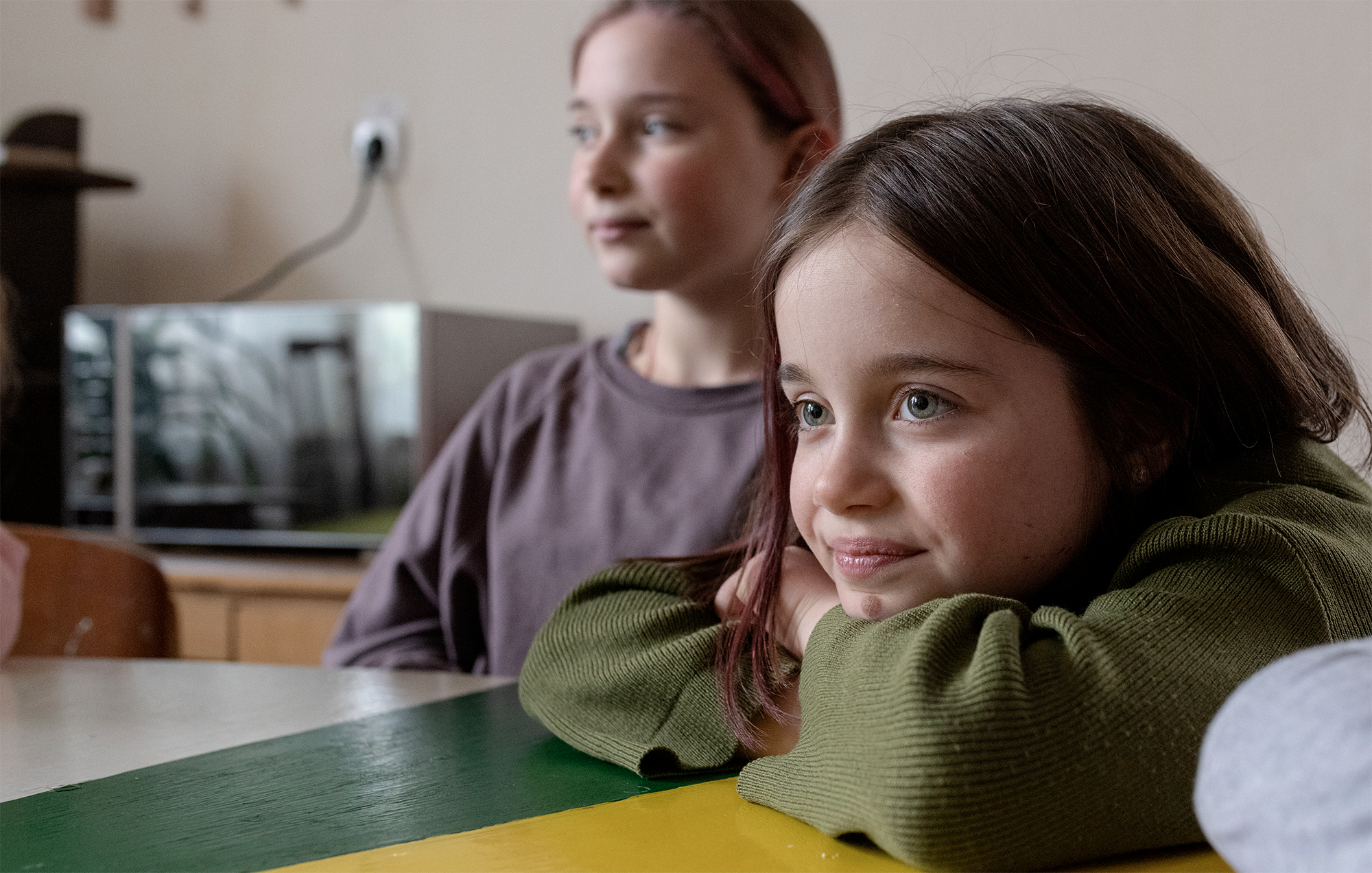
During the first months of the war, AVSI established Child-Friendly Spaces (CFS) and Digital Learning Centres (DLCs) in reception centres for displaced people and in schools in affected communities along the frontline. These spaces provided children with access to online learning, psychosocial support, recreational activities, and safe environments where they could reconnect with peers and regain a sense of normality despite the ongoing conflict.
As the humanitarian situation evolved, AVSI shifted from temporary interventions towards more sustainable, community-based solutions.
In 2026, AVSI established Community Centres (CCs) within educational facilities located near the frontline. These centres are designed to function simultaneously as CFSs and TLCs, ensuring that schools and communities can continue using and maintaining them even after project activities are completed.
During 2026 alone, AVSI supported the creation of 5 Community Centres in Dnipro Oblast, 1 in Kharkiv Oblast, 4 in Odesa Oblast, 4 in Mykolaiv Oblast, and 1 centre each in Sumy, Kherson, and Zaporizhzhia Oblasts.
Within these centres, children receive tailored remedial education aimed at addressing learning losses accumulated over years of disrupted schooling.
AVSI’s educational approach is based on adapting learning activities to children’s age, gender, and disability-related needs, ensuring that support remains inclusive and accessible. At least 30% of all educational sessions are dedicated to psychosocial support, emotional learning, and activities that strengthen resilience, social skills, and emotional regulation. This integrated methodology has proven its importance and effectiveness, recognising that children cannot fully recover academically without also addressing the psychological impact of war.
Special attention is given to children with disabilities and special educational needs. In addition to inclusive educational activities, AVSI provides individual support through speech therapy consultations and the involvement of inclusive education officers who work directly with children and caregivers to respond to specific developmental, behavioural, and educational needs.
Through this work, AVSI aims to support children in engaging more actively in learning processes and to strengthen the capacity of families and schools to ensure inclusive education in challenging contexts.
Alongside direct support to children, AVSI continuously works with teachers, school staff, caregivers, and local authorities throughout project implementation. Teachers receive ongoing methodological, psychosocial, and organisational support to help them adapt to crisis-sensitive education approaches and manage the challenges of teaching in wartime conditions. The organisation also maintains close cooperation with local NGOs, schools, and community actors to ensure that interventions remain relevant, sustainable, and closely aligned with the realities faced by frontline communities.
Through close collaboration with local authorities and organisations, AVSI aims to restore access to education and strengthen protective environments where children can learn, recover, socialise, and rebuild hope for the future despite the prolonged impact of war.
Mobile teams: education and protection in remote areas
Where it is not possible to establish a Community Centre due to security risks, ongoing hostilities, or the absence of suitable infrastructure, AVSI operates through Mobile Teams (MTs) composed of educators, social workers, psychologists, and a driver. The team regularly travels to remote and hard-to-reach communities across frontline oblasts to ensure that children and families continue receiving essential educational, psychosocial, and protection support despite limited access to services.
The work of the Mobile Teams goes far beyond the delivery of activities. Social workers and psychologists play a key role in conducting continuous needs assessments directly within communities through individual consultations, home visits, focus group discussions, and regular communication with caregivers, teachers, local authorities, and community representatives. This constant engagement allows teams to identify emerging protection risks, educational gaps, mental health concerns, and urgent humanitarian needs in real time, ensuring that support remains flexible and responsive to the rapidly changing context.
During field visits, Mobile Teams organise remedial education activities, psychosocial support sessions, recreational activities, awareness-raising events on child protection and parenting, as well as individual consultations for children and caregivers.
Special attention is given to children with disabilities, children showing signs of distress, and families facing particularly vulnerable living conditions. Teams also provide referrals to specialised medical, psychological, legal, and social services when additional support is required.
Humanitarian aid in Ukraine for displaced persons in reception centers in Lviv and Poltava
In the first year of the war, AVSI distributed food and life-saving non-food items, personal hygiene and COVID-19 protection kits, cash assistance, and winter kits.
In the shelters (5 in Lviv and 28 in the Poltava region), AVSI supported the coordination of volunteers, the census and registration of families, and the identification and referral of people with specific needs or vulnerabilities (women, separated or unaccompanied minors, people with disabilities) to specialised services.
AVSI also equipped the 28 centres in the Poltava region with electric radiators and trained educators in the five centres in Lviv on parenting support issues.
Beyond humanitarian aid in Ukraine: AVSI's voice for Ukrainian children
It is essential to recognise that the future of Ukrainian children is closely intertwined with the future of all children. For this reason, AVSI promotes advocacy initiatives and awareness-raising events worldwide as part of the “Peace is Possible” campaign.
We cannot think ourselves safe if others are not. Peace is everyone's or no one's.
Giampaolo Silvestri, AVSI Secretary General at the UN High Panel "Gross Human Rights Violations Due to the Aggression Against Ukraine" on February 23, 2023
Ukrainian refugees: projects to support them in Italy and Poland
With the beginning of the war in Ukraine, thousands of people crossed the border into Europe, mainly women, older people, and children. Thanks to AVSI’s network in Poland, Romania, and Moldova, support has been provided to Ukrainians in transit and to those who have chosen to stay.
In Poland, AVSI collaborates with AVSI Polska, a Polish organisation and founding member of the AVSI network. After the initial emergency response, activities have focused on integration, in cooperation with local companies and with the support of private donors.
In Italy, an initiative was established to aid individuals fleeing the war in Ukraine. The initiative involved creating a central point for information and coordination, which allowed for support services to be centralized for Ukrainian refugees and connecting those offering help with those in need. Eventually, the initiative found a permanent home in a space located in Milan. On May 16, 2022, the HUB Help Ukraine was inaugurated, and it now serves as the headquarters of AVSI for the community that continues to support Ukrainians in Italy.
*What are the oblasts of Ukraine?
The regions of Ukraine (Ukrainian: області - oblasti; sing. область - oblast') constitute the first-level territorial subdivision of the country and there are 24 in total. Since the beginning of the war, AVSI has worked in 7 oblasts of eastern Ukraine: Donetsk, Dinipro, Kharkiv, Lviv (Lviv), Poltava, Sumy, Zaporižžja


