AVSI in Rwanda
- Kigali HQ Office
KG 145 Street House No 10
Kimironko,
Po.Box 3185 | Phone: +(250) 798 288 812
[email protected] - Gasange Office
Eastern Province, Gasange, Gatsibo
Phone: +(250) 788 557 803 - Gicumbi Office
Northern Province, Rukomo, Gicumbi
Phone: +(250) 788 734 336, +(250)787851602 - Gicumbi – Nyamiyaga Office
Northern Province, Nyamiyaga, Gicumbi
Phone: +(250) 788 739 922 - Kamonyi Office
Southern Province,Musambira, Kamonyi
Phone: +(250) 788 602 966 - Ruhango Office
Southern Province, Ruhango
Phone: +(250) 783 220 233 - Nyanza Office
Southern Province, Kigoma, Nyanza
Phone: +(250) 788 758 912 - Nyamasheke Office
Western Province, Kagano, Nyamasheke
Phone: +(250) 784 890 942

AVSI started working in Rwanda in 1994, just after the Genocide against the Tutsis, initially engaged in humanitarian emergency interventions.
Today, AVSI Rwanda is a registered local organization operating in 7 rwandan districts in different areas of intervention. We accompany more than one thousand people through projects in Education, Child Protection and Youth Rights, Gender Equality and Women’s Empowerment, Mental Health, Economic Empowerment, Climate Change and Agriculture.
1994 Genocide against the Tutsis in Rwanda
The 1994 Genocide against the Tutsis, a tragic chapter in Rwandan and human history, had profound and lasting effects on the nation's social and economic fabric. The systematic massacre of more than one million Tutsis in a span of only 100 days left Rwanda in a state of devastation.
Communities were destroyed, families torn apart and social trust eroded. The genocide also disrupted economic stability, destroyed the infrastructures, damaged agricultural production.
However, through determined efforts, Rwanda has achieved significant strides in the process of rebuilding its society and economy, experiencing notable growth along the way. Rwanda today aspires to become a middle-income economy by 2035 – as the World Bank stated.
AVSI began its work alongside the Rwandan population in 1994, when it was one of the first international organizations to cross the border from Uganda to support the victims of the genocide by providing them with humanitarian aid and basic needs.
Rwanda today: the heavy genocide heritage and the timeless challenges
Rwanda, a densely populated country of 14.1 million people has made substantial progress in areas like poverty reduction, gender equality, education, and public health over the past three decades, aligned with Sustainable Development Goals. Nevertheless, significant challenges persist.
Roughly 27.4% of the population still lives below the poverty line according to Rwanda's national statistics, with nearly one-fifth facing food insecurity, especially in rural areas where three quarters of the population reside. Poverty affects children from low-income households most significantly, with concerning issues like high rates of child stunting, no access to quality education and poor health.
Nurturing mental well-being in Rwanda: overcoming stigma and trauma
Rwandans, including survivors, witnesses, and even subsequent generations, still face deep-rooted mental health issues, stemming from the 1994 Genocide against the Tutsis, including depressive disorders, post-traumatic stress disorder, and substance misuse. Stigma surrounding mental health perpetuates these problems and undermines families’ well-being by contributing to misunderstanding, conflicts and incidents of violent behaviour.
Rural households often experience domestic conflict, violence, and untreated mental health conditions such as trauma, depression, and anxiety. These challenges negatively impact parenting and child development.
AVSI Rwanda promotes psychosocial support, parent support groups, awareness on child protection and gender-based violence, and community-based rehabilitation. We also support adolescent mothers facing stigma, poverty and limited educational opportunities.
The vulnerability of Rwandan women and girls
Women and girls are more exposed to mental health disorders which amplify their vulnerability and lead to gender-based violence, unintended and early pregnancies, risk of sexually transmitted diseases, etc. These phenomena strongly undermine their social and economic development. Women's school dropout and unemployment rates are higher than men's.
Climate-induced challenges compounding food insecurity in Rwanda
Beyond these challenges, climate-related issues like irregular rainfall, droughts, floods, along with limited arable land, pests, and diseases exacerbate food insecurity in Rwanda.
Specifically, almost one fifth of the population suffers from food insecurity, and 32.4% of children under 5 years suffer from chronic malnutrition (source World Food Program). Given that agriculture is a cornerstone of the economy involving 69% of households, climate-related issues pose a significant threat to family livelihoods and overall economic stability.
Rebuilding lives: development projects alongside vulnerable communities
Core cross-cutting approach in all AVSI Rwanda interventions is the PACOME Model, (French acronym for PArents, COMmunautés, Écoles), a partnership between parents, schools, and communities. Indeed, AVSI Rwanda collaborates with community actors, including health centres, financial institutions, religious organisations, civil society organisations and local authorities.
Our holistic model integrates social, economic and educational dimensions to create long-lasting change. Through PACOME, we focus on:
- Education, Technical and Vocational Training, and Employment
- Family Strengthening and Women’s Empowerment
- Health and Nutrition
- Environment, Agriculture, and Economic Development
The commitment of more than 1000 community volunteers allows staff and partners in the field to enter people's homes, work closely with beneficiaries, then follow individual paths and learn about critical issues in the areas of intervention
Side by side with people suffering from mental health disorders
Through the CARE Project (Comprehensive solutions for increased Access to mental health care and Rooted in communities and Enhancing public services), AVSI Rwanda aims to boost the resilience of people affected by Mental Health, Neurological and Substance Abuse (MNS) disorders and their families.
Through a community-based approach, AVSI Rwanda is committed to combat the cultural stigma that prevents those with MNS disorders from being an integral part of society, while also increasing knowledge and acceptance of the disease through promotional events and information dissemination. The organization collaborates with national and governmental institutions, hospitals, health centres and community mental health volunteers to enable access to treatment and healthcare and foster recovery and socio-economic rehabilitation.
From 2021 to 2025 more than 13,108 people affected by MNS disorders have benefitted from AVSI Rwanda’s CARE Project.

AVSI’s Distance Support Program in Rwanda
The Distance Support Program was one of AVSI’s first interventions in Rwanda. In its initial phase, it focused on supporting children who survived the genocide: a team of doctors, psychologists, and social workers worked to reunite families separated by the violence, assist vulnerable households, and address collective trauma.
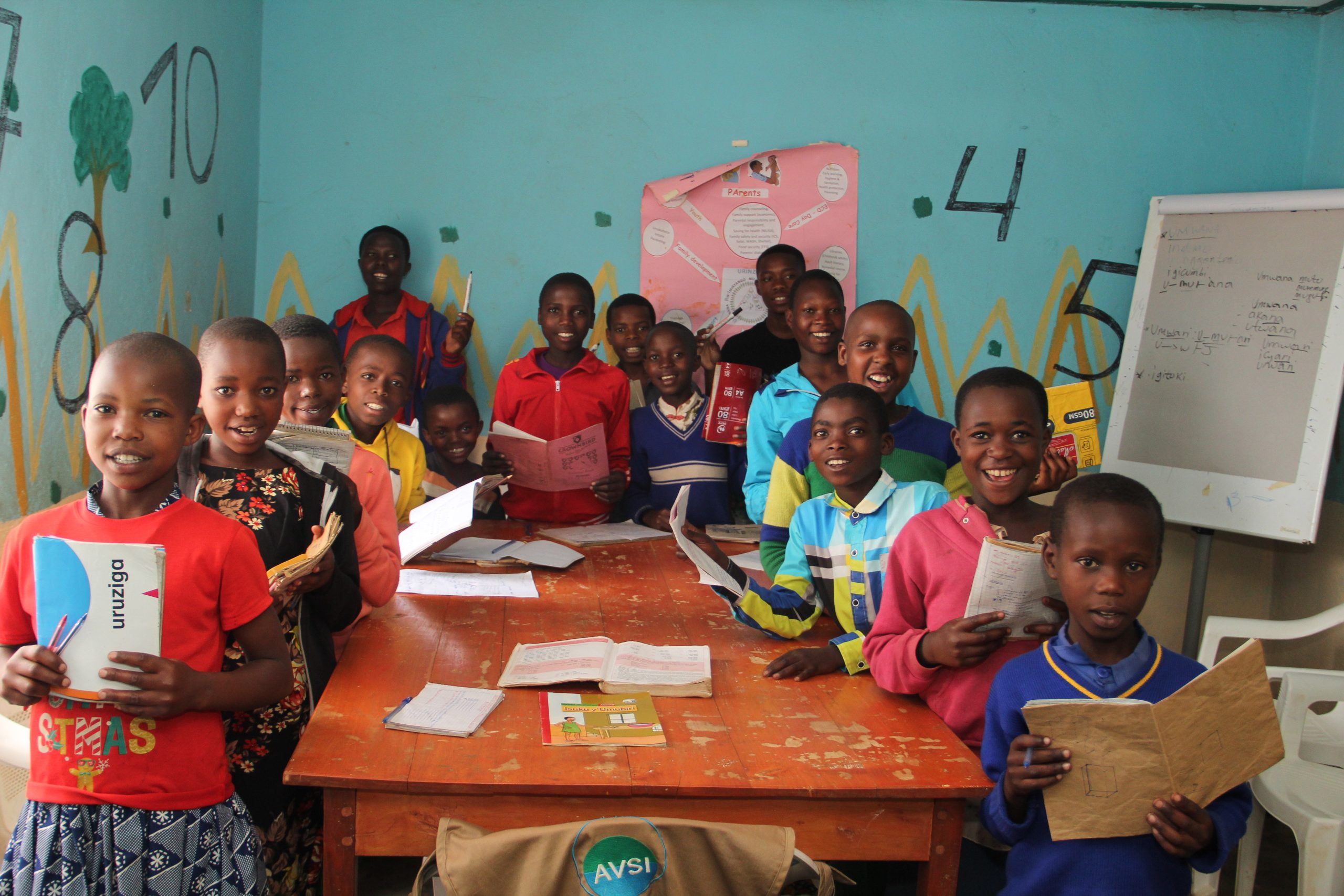
Today, the program operates in six districts across Rwanda and supports more than 1,200 children and adolescents living in rural and remote areas with limited opportunities. The beneficiaries face extreme vulnerability: thanks to the program, they are accompanied through an educational pathway that also involves their caregivers, offering literacy courses and awareness activities on nutrition, health, and hygiene.
Over more than 30 years, AVSI’s integrated Distance Support approach—combining education, psychosocial assistance, economic strengthening, child protection, and environmental actions—has proven to be a highly effective way to support a population deeply affected by violence and poverty.
Empowering teenage mothers in Rwanda
In Rwanda, studies show a rapid increase in the rate of teenage pregnancy over the past two decades, despite policy achievements to empower women and efforts to reduce women and child sexual abuse. Towards this, AVSI Rwanda works for reducing vulnerability of teenage mothers and their children by building their life skills, raising-awareness on violence and abuse against girls, foster socio-economic reintegration, to eventually enable them to take concrete steps toward achieving their goals.
From 2019 until today, 580 teenage mothers and their children have been supported by AVSI Rwanda through counselling, psychological and psychosocial aid, literacy and vocational training, access to legal services, and the creation of early childhood development centres.
AVSI Rwanda's embrace of environmental conservation
Over the past few years, AVSI Rwanda has taken significant strides towards incorporating environmental preservation as a fundamental aspect of its initiatives. This strategic integration underscores AVSI Rwanda's dedication to not only addressing immediate needs but also fostering long-term sustainability. Among the diverse range of activities initiated, AVSI Rwanda has prioritized the distribution and installation of improved cook stoves (ICS) to reduce deforestation and indoor air pollution. Additionally, AVSI has embarked on agroforestry programs to combat soil erosion and promote biodiversity. Furthermore, AVSI Rwanda actively promotes the productive utilization of renewable energy sources, thereby contributing to both environmental conservation and improved livelihoods within the communities they serve.