AVSI in Libya
- Tripoli Office
Libya today: a country in protracted transition
After the end of the Gaddafi regime in 2011 and the ensuing civil war, the situation in Libya remains unstable. The country is divided, both politically and territorially, between East and West.
The end of the war in Tripoli and the ceasefire signed in Geneva on the 23rd October 2020 between the government in Tripoli and the forces in Benghazi put an end to hostilities. The country's conflict has evolved from an open civil war into a durable stalemate: rival authorities persist, armed groups remain embedded in state structures, and recurring cycles of violence continue to undermine stability - generating periodic crises, service collapse, and chronic insecurity.
A divided political landscape
According to the International Organization for Migration Libya Crisis Response Plan 2025-2026, the postponement of national elections, originally scheduled in December 2021, has further deepened institutional fragmentation, and intensified tensions among competing political groups, negatively affecting the socioeconomic conditions of the Libyan population.
National political institutions have lost credibility in the eyes of many Libyans, and the country remains without a unified, elected government.
In this context, local institutions, mayors and municipalities, remain the most reliable interlocutors for restoring basic services and building community-level stability.
787,000 people in need of humanitarian assistance
According to the OCHA, Libya Humanitarian profile, 2025, an estimated 787,090 people, including internally displaced persons, migrants, refugees, and asylum seekers, continue to require humanitarian assistance. As of August 2024, Libya was hosting 139,305 internally displaced persons (IDPs), including people displaced by conflict as well as by the impacts of Storm Daniel.
A deteriorating economy and weakened public services
According to the OCHA, Libya Humanitarian profile, 2025, Libya continues to face significant economic and public service challenges.
In April 2025, the Libyan dinar was devalued by 13.3%. In practical terms, a 13.3% it means that if a product previously cost the equivalent of €100 to import, it would now cost around €113, increasing prices for fuel, food, medicine, and other essential goods that rely on imports.
Essential services, particularly in the electricity, health, and water sectors, remain inconsistent and insufficient to meet growing demographic pressures.
WASH services remain critically strained as a result of deteriorating infrastructure, especially in eastern and southern Libya, where inadequate sanitation systems and contaminated water sources continue to increase the risk of waterborne diseases.
The report also highlights major barriers affecting access to education, noting that approximately 43% of Sudanese refugee children are out of school due to legal, financial, and logistical constraints.
Climate shocks compounding existing vulnerabilities
Libya faces severe environmental and water-related challenges, exacerbated by climate change, conflict, and weak infrastructure. The impact of storm Daniel in 2023 and repeated flooding episodes highlight the country’s vulnerability to climate shocks and the urgent need for resilient systems.
According to the World Population Review Water Stress by Country 2026, Libya ranks among the world’s 11th most water-stressed countries, with projections indicating increasing pressure on water resources in the coming decades. The country relies heavily on the Great Man-Made River (GMMR), a vast network of underground pipes and wells designed to transport fossil groundwater from desert aquifers in southern Libya to densely populated coastal cities in the north. Often described as one of the largest water engineering projects in the world, the system supplies a significant share of Libya’s freshwater needs for households, agriculture, and public services. However, years of conflict, damage to infrastructure, and limited investment in maintenance have weakened the system, contributing to growing concerns over water shortages and access to safe water across the country.
While access to water is widespread, its reliability and quality remain limited, and inadequate wastewater systems pose serious public health risks. These challenges are compounded by weak governance and limited municipal capacity, with women and girls disproportionately affected, particularly in rural areas.
Education and child protection: a generation at risk
Children remain among the groups most severely affected by Libya’s protracted crisis. According to UNICEF Libya’s Annual Report 2024, approximately 340,000 children in the country were in urgent need of humanitarian assistance as of December 2024.
Access to education continues to be significantly constrained. OCHA’s Libya Humanitarian Profile (2025) reports that 43% of Sudanese refugee children are out of school, while 78% of children from sub-Saharan migrant communities lack access to formal education. Financial hardship, lack of documentation, and language barriers remain among the main obstacles preventing children from attending school.
Libyan children are also affected, with overcrowded classrooms and a lack of qualified teachers driving high dropout rates across the country. Child protection concerns run equally deep: unaccompanied minors and children on the move face heightened risks of exploitation and abuse, with limited legal protection.
AVSI in Libya: rehabilitating services and building community resilience
In Libya, AVSI has been working since 2023 to improve access to services and strengthen local institutions, combining infrastructure rehabilitation, capacity building and community-based interventions. AVSI is operational in the East and West of country, and works across multiple regions of the country in partnership with local authorities, civil society organizations.
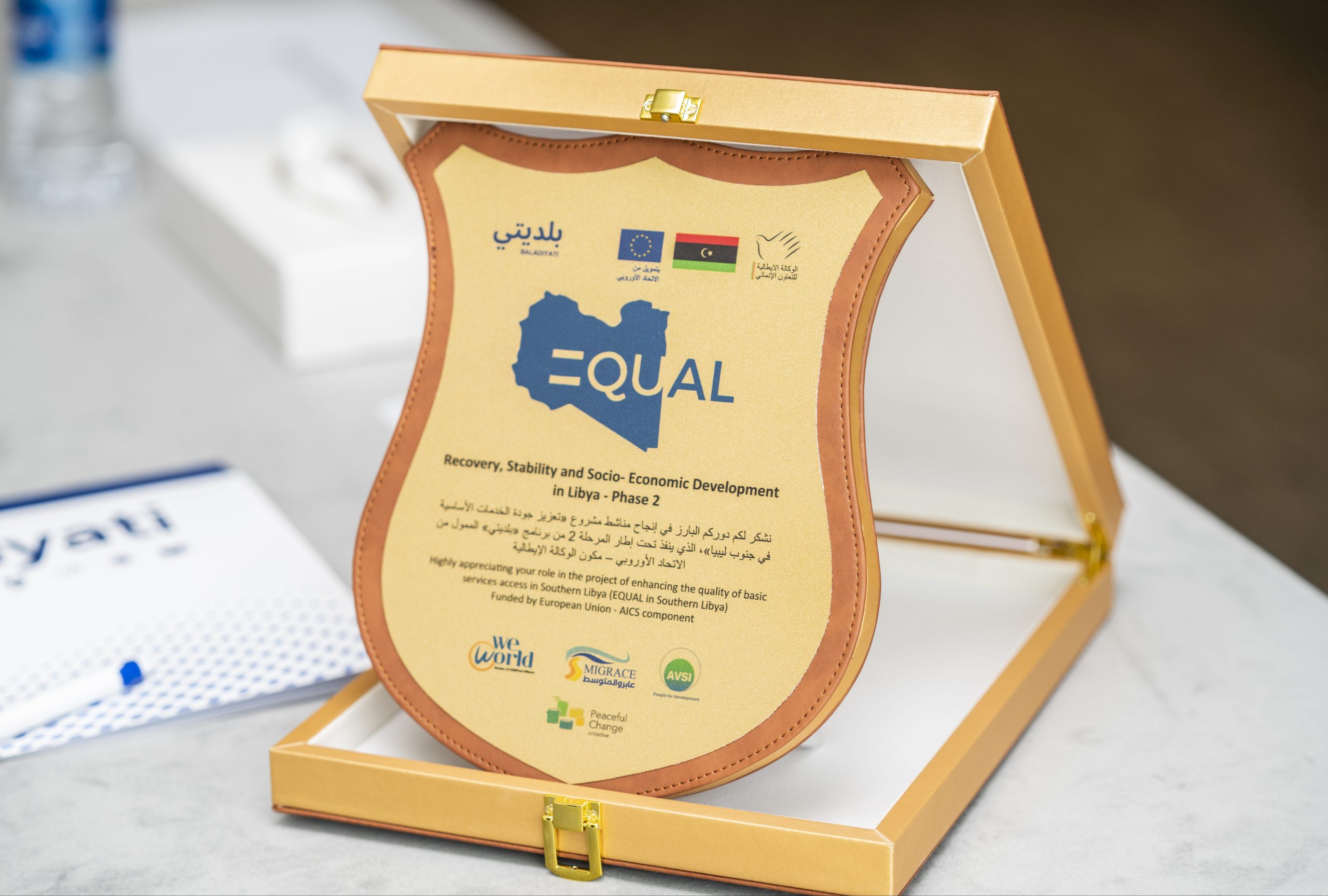
AVSI has established its presence in Libya through the implementation its first project: EQUAL — Enhancing the Quality Basic Services Access in Southern Libya project (2023–2024), funded by the Italian Agency for Development Cooperation (AICS).
Launched in February 2023, and implemented across the municipalities of Darj, Sinawn, Ash Shwayrif, Al Gorda, and Brak al Shati, the project marked AVSI’s first intervention in the country and focused on strengthening the role and capacities of local municipalities in supporting peacebuilding and improving access to essential services.
Through the rehabilitation of infrastructure, the installation of solar energy systems in health centres, and support to solid waste management services, the project contributed to improving living conditions in targeted communities in southern and north-western Libya. The intervention also placed strong emphasis on sustainability through capacity-building activities for public officials and service providers, alongside community awareness initiatives promoting inclusive access to basic services.
Active projects
- JUSUR — Promoting bridges of tolerance and respect in Libyan society (Tripoli — funded by Fondazione Sacchi & Iveco Foundation, in partnership with the Libyan Scouts Movement - 2025-2026).
AVSI launched JUSUR in 2025 to address the psychosocial and social cohesion needs of young people in vulnerable neighborhoods of Tripoli. The project creates a sustainable psychosocial support network through scout leaders and youth groups, promoting mental health awareness and the social integration of young people - including migrants and minorities. Working in three Scout centers in the Libyan capital, AVSI and its partners deliver recreational and educational programs, intercultural activities, remedial school courses and psychosocial support to children aged 6 to 15.
The project trains 22 regional Scout executives and 260 educators across Libya's 22 regions in psychosocial support, with a cascading training approach designed to ensure national reach and long-term sustainability. Direct beneficiaries include 750 children and young people, with an indirect reach of over 18,500 Scout members and 3,000 family members. A training center is also being rehabilitated, in the old Medina of Tripoli, to serve as a permanent community hub.
The Libyan Scout Movement has long been one of the country’s most respected and resilient youth institutions. Currently, it maintains an active presence across all regions of Libya, operating in more than 160 cities and municipalities through local scout groups and community centers. The movement is estimated to include approximately 70,000 members and volunteers nationwide, involved in its activities across the country.
- AQUA — Improved access and water resources management (Municipalities of Al Abyar and Sahil Al Jabal, East Libya — funded by AICS, in partnership with WeWorld, COOPI & MM Spa – 2026-2027) As part of a consortium intervention in six Libyan municipalities, AVSI implements activities in Al Abyar and Sahil Al Jabal (Eastern Region) to improve access to safe water and sanitation services, combining infrastructure, capacity building, and community engagement.
- Water supply and distribution: AVSI supports the installation of public drinking water stations based on reverse osmosis systems, and provides equipment to strengthen water distribution and maintenance. The project also establishes water quality monitoring laboratories and trains municipal staff in their operation and in water system management, ensuring safer and more reliable water services.
- Sanitation services: AVSI improves sanitation infrastructure through the provision of equipment and targeted maintenance works, particularly in public facilities. In Al Abyar, a pilot nature-based wastewater treatment system is also implemented. These interventions are complemented by technical training and community awareness campaigns to promote safe hygiene practices.
- Governance and capacity building: AVSI contributes to strengthening local governance by building the technical and managerial capacities of municipalities. This includes training on water and sanitation service management, data collection, and support to the development of integrated water management plans, enhancing the sustainability and efficiency of service delivery.