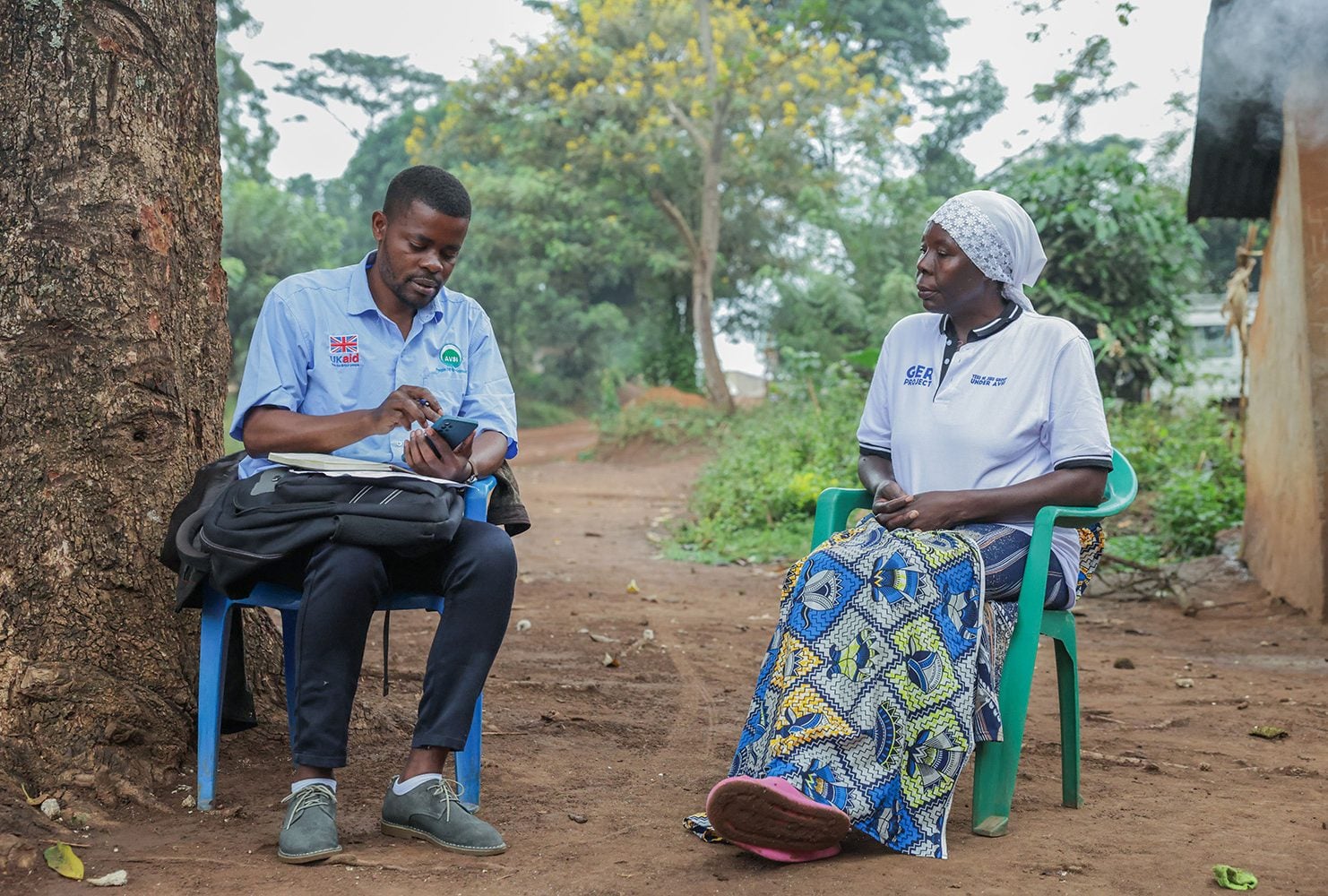
Partnership for Economic Inclusion (PEI) defines the Graduation Approach as a bundle of coordinated, multi-sectoral interventions that support individuals and households to increase their income and assets, while at AVSI Foundation, we add that it is a sequenced and time-bound intervention that aims to help people living in extreme poverty build resilience and engage in sustainable livelihoods.
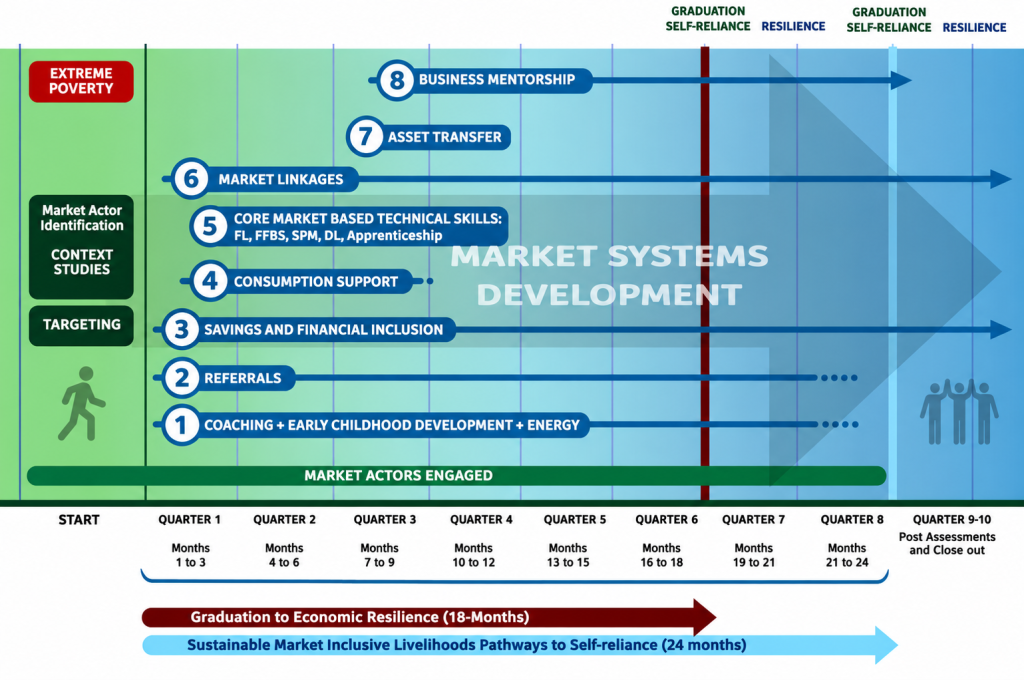
Graduation programmes are increasingly being recognised as one of the most effective approaches for working with extremely poor households to move towards self-reliance and resilience. However, the success of these programmes does not depend solely on delivering the project components, which mainly include, in the case of
Sustainable Market Inclusive Livelihood Pathways for Self-Reliance (SMILES) and Graduation to Economic Resilience (GER), as shown in Figure 1 below.
The projects demonstrate how strong Monitoring, Evaluation, Accountability and Learning (MEAL) systems can transform a graduation programme from a collection of activities into an evidence-driven pathway for sustainable change.
Implemented in refugee and host communities in Kyegegwa and Kikuube Districts of Southwest Uganda, SMILES and GER were designed to support extremely poor households through the Graduation Approach integrated with Market Systems Development (MSD). The projects recognised from inception that poverty is multidimensional and dynamic. Therefore, measuring change required more than simply counting project participants or reporting completed activities. Instead, both initiatives established a comprehensive MEAL framework capable of tracking household progress, identifying challenges, testing assumptions, and supporting adaptive management throughout implementation.
One of the most important contributions of measurement in a Graduation programme is the ability to assess whether interventions are actually improving lives. The integrated MEAL plans from both projects are identical, clearly stating that monitoring and evaluation are intended to measure project outputs and outcomes, assess progress, document lessons learnt, and provide evidence for decision-making.
- Through routine monitoring and annual participant-based assessments, the projects continuously track whether households are gaining technical skills, accessing financial services, engaging in productive businesses, and improving their wellbeing, thus moving out of extreme poverty. This enables project teams to understand what activities were implemented and, more importantly, whether these activities are producing meaningful and lasting results.
Measurement for Accountability
Graduation programmes often involve multiple stakeholders, including funders, governments, implementing partners, market actors, and community members. In SMILES and GER, detailed performance indicators were established to monitor household participation, business expansion, graduation from extreme poverty, resilience after graduation, and market actor engagement. By systematically collecting and analysing data, the projects ensure transparency and accountability to participants, host governments, and funders. This helps stakeholders understand whether resources are being used effectively and whether interventions are reaching the intended populations.
Measurement for supporting adaptive management
Graduation programmes operate in highly volatile environments where economic shocks, climate change, disease outbreaks, and market fluctuations can easily affect household progress. Recognising this reality, the projects embedded assumptions and risk monitoring directly into their Theory of Change frameworks. They track inflation, land access, market prices, climatic conditions, and policy changes because these external factors can influence household resilience. By monitoring these contextual factors, programme teams can adjust implementation strategies in response to changing realities rather than wait until the end of the project to discover failures.
Measurement for Learning: SMILES and GER illustrate how measurement improves learning. Through their Collaborating, Learning, and Adapting (CLA) framework, regular reflections and feedback mechanisms were established to analyse findings and identify opportunities for improvement. This learning-oriented approach recognises that graduation is not a linear process. Some interventions may work better than others depending on household characteristics, gender dynamics, market conditions, or environmental factors. Continuous learning allows programmes to refine approaches, strengthen effective interventions, and discontinue ineffective practices.
Measurement beyond economic indicators: In graduation programming, measurement must go beyond economic indicators alone. In both projects there is a clear demonstration of a holistic approach with the inclusion of environmental, gender, energy, and market systems considerations into the entire MEAL framework. For instance, tracking of women’s participation in gender-led activities, access to clean energy technologies, and the promotion of environmentally sustainable livelihoods. This broader perspective acknowledges that resilience is not defined only by income, but also by social inclusion, empowerment, sustainability, and the capacity to withstand shocks.
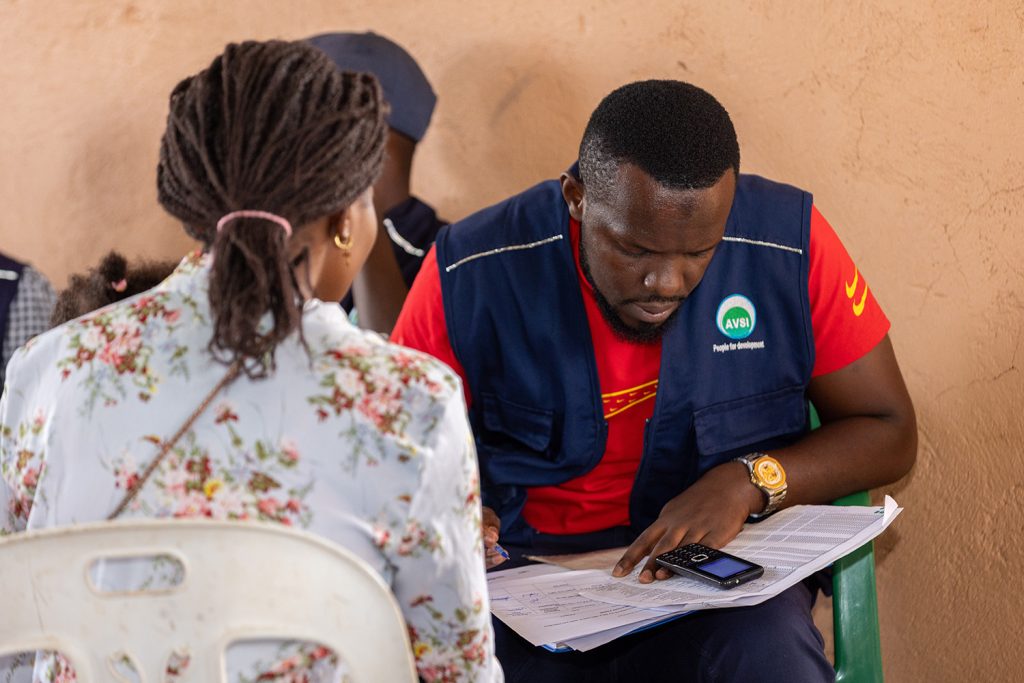
Measurement strengthened by technology: The use of technology and data systems further strengthens measurement in graduation programming. SMILES and GER developed a Management Information System (MIS) linked to mobile-based data collection tools to enable real-time reporting, data verification, and analysis. Unique household identification codes were established to track participant progress throughout the project lifecycle. These systems improve data accuracy, timeliness, and accessibility while enhancing decision-making efficiency and real-time data utilisation.
For storage and management of data as well as its quality, the measurement procedures clearly demonstrate that data quality assurance is an essential element for which reliable evidence is only possible when data is valid, complete, precise, reliable, and timely. The measurement process, including quarterly Data Quality Assessments (DQAs), the use of Lot Quality Assurance Sampling (LQAS), staff training, and systematic verification procedures to ensure high-quality data collection and reporting, demonstrates that measurement ensures information is accurately collected and guarantees its integrity and credibility.
Measurement for sustainability purposes: SMILES and GER projects redefine graduation measurement itself as a process of measuring progress rather than simply removing assistance. The projects explicitly state that graduation measurement should not be viewed as moving people off support, but rather as assessing household progress across multiple indicators related to resilience, economic capacity, and self-reliance. This perspective emphasises that measurement supports programmes to understand how households are transforming over time and whether they are capable of sustaining improvements beyond the life of the project.
Measurement for Advocacy: Strengthening advocacy and influencing broader development and humanitarian responses is one of the main contributions of measurement. In graduation programming, credible evidence helps demonstrate what works, why it works, and how integrated approaches can support vulnerable households to move towards resilience and self-reliance. The experiences from the SMILES and GER projects show that strong measurement systems can generate valuable insights for governments, funders, and other development partners by highlighting changes in livelihoods, resilience, market participation, and household wellbeing. This evidence helps position graduation approaches as sustainable and scalable solutions for addressing multidimensional poverty among both refugee and host communities. By combining routine monitoring, learning, and data-driven reflection, measurement becomes a powerful advocacy tool that supports informed decision-making, resource mobilisation, and policy dialogue. Ultimately, effective measurement strengthens the ability of programmes to communicate impact, promote accountability, and advocate for more inclusive and evidence-based development interventions.
In conclusion, measurement is not a bureaucratic requirement; it is the engine of effective graduation programming. As demonstrated by the SMILES and GER projects, strong MEAL systems transform good intentions into demonstrable impact. They enable accountability, adaptive management, learning, sustainability, and advocacy. In the volatile environments of refugee and host communities, measurement provides the evidence needed to guide implementation, influence policy, and mobilise resources. By tracking what truly matters beyond income to include resilience, empowerment, and wellbeing, measurement ensures that graduation programmes genuinely support households in moving towards self-reliance. Ultimately, investing in strong measurement systems is essential for achieving sustainable and scalable solutions to multidimensional poverty in vulnerable communities.